

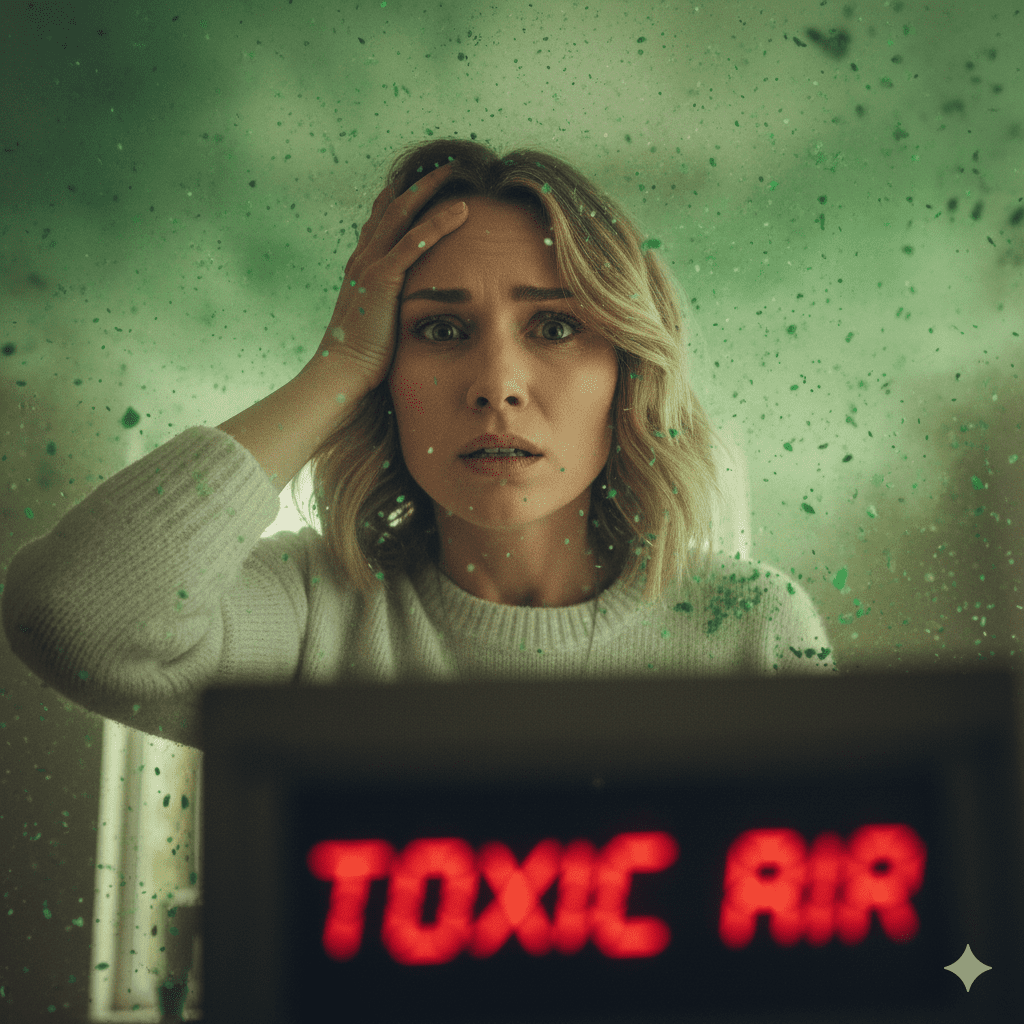
You changed your air filter six months ago.
Maybe it was eight months. Could’ve been a year. You’re not entirely sure, but you remember thinking, “I’ll get to it next month,” and then life happened.
Here’s the truth: That innocent-looking rectangle of pleated paper hiding in your HVAC system is waging a silent war against everything you care about. Your energy bills. Your health. The lifespan of your expensive heating and cooling equipment.
And you’re letting it win.
The $500 Mistake You’re Making Right Now
Let me paint you a picture.
Every day, your HVAC system circulates about 1,000 cubic feet of air through your home. That’s roughly the volume of a two-car garage flowing through your vents every single hour. And every molecule of that air passes through one critical checkpoint: your air filter.
When that filter is clogged with dust, pet dander, pollen, and microscopic debris, your system doesn’t just work harder. It gasps. It strains. It burns through electricity like a teenager burns through data, desperately trying to push air through a barrier that’s essentially become a solid wall.
The average homeowner with a neglected air filter pays an extra $30 to $50 per month in energy costs. That’s $600 a year. Every year. For the privilege of breathing worse air and destroying their HVAC system faster.
But the money? That’s just the beginning.
What’s Really Floating Around Your Living Room
Close your eyes and imagine your lungs.
Now imagine them as air filters, because that’s essentially what they are. And when your actual air filter stops doing its job, your respiratory system becomes the backup plan.
A dirty air filter doesn’t filter. It releases. All those trapped particles that should be locked away in the fibers? They’re breaking free and taking a tour of your home. Landing on your furniture. Settling into your bedding. And yes, entering your lungs with every breath.
We’re talking about mold spores that trigger allergies and asthma attacks. Bacteria colonies that multiply in the moist, dark environment of a clogged filter. Volatile organic compounds that off-gas from household products and have nowhere to go except into your bloodstream.
The EPA estimates that indoor air can be two to five times more polluted than outdoor air. Sometimes, it’s a hundred times worse. And your neglected air filter is the ringleader of this invisible circus.
The Domino Effect You Never See Coming
Here’s where it gets expensive.
Your HVAC system was designed with a specific airflow in mind. Engineers calculated the precise cubic feet per minute needed to keep your home comfortable without overtaxing the equipment. A clean filter was part of that equation.
When airflow drops because your filter is clogged, your system doesn’t just work harder. It starts failing in slow motion.
The blower motor overheats because it’s straining against resistance. Your evaporator coil freezes because warm air can’t reach it. Your heat exchanger cracks because temperatures spike beyond design specifications. Each of these failures costs $400 to $1,500 to repair.
And then there’s the big one: complete system replacement. The average HVAC system costs $5,000 to $10,000. A properly maintained system lasts 15 to 20 years. A neglected one? Seven to ten years if you’re lucky.
Do the math. Ignoring a $20 air filter can cost you thousands of dollars in premature replacement costs.
The Four Words That Changed Everything
“Let me check that.”
That’s what a smart homeowner says when they can’t remember the last time they changed their filter. Not next week. Not when they remember. Now.
Walk to your HVAC system right now. Open the access panel or the return air grille. Pull out that filter and hold it up to the light.
Can you see through it? If the answer is no, or if you’re squinting and convincing yourself that “maybe a little light is getting through,” you’re already in trouble.
Here’s your new rule: Change your air filter every 30 to 90 days, depending on your circumstances. Have pets? Monthly. Live in a dusty area? Monthly. Run your system constantly? Monthly.
No pets, minimal dust, and you’re barely home? You might stretch it to 90 days. But set a reminder. Put it on your calendar. Tie it to a recurring expense like your mortgage payment. Make it automatic, because your memory is unreliable and your HVAC system doesn’t care about your excuses.
The Upgrade That Actually Matters
Not all air filters are created equal.
That basic fiberglass filter you’ve been buying at the hardware store for $3? It’s essentially a screen door trying to stop mosquitoes. It catches the big stuff and waves at everything else as it passes through.
You want a MERV rating between 8 and 13. That’s the sweet spot where you capture the particles that actually matter—pollen, mold spores, dust mites, bacteria—without restricting airflow so much that you create new problems.
MERV 8 to 11 filters cost $20 to $40 and work for most homes. MERV 13 filters, which catch even smaller particles, run $30 to $50 but might be necessary if someone in your household has asthma or severe allergies.
Yes, it’s more expensive than the $3 filter. It’s also the difference between breathing clean air and operating a mobile respiratory hazard in your own home.
The One Thing You Need to Remember
Your air filter isn’t just a component in your HVAC system.
It’s the frontline defense for your health, your comfort, and your bank account. Ignore it, and you’re not saving money or time. You’re taking out a loan against your future, and the interest rate is brutal.
Change your filter. Mark your calendar. Upgrade if necessary.
Here’s what to do next:
📞 Call Us Now: (864) 295-1541
Request a free quote
or Schedule a service
Your lungs will thank you. Your wallet will thank you. And your HVAC technician will stop sending you those expensive repair bills that could’ve been prevented with a $30 filter and five minutes of effort.
The choice has always been yours. The only question is whether you’ll make it before that filter makes it for you.